Sub-Zero freezer running warm while the refrigerator stays cold
A Pleasanton Sub-Zero freezer drifting warm while the fridge stays cold has its own refrigeration to blame — an iced coil, a dead defrost part, a stalled fan, or a condenser cooked by valley heat. Check it before you call.
The thing that throws people is that the refrigerator half is perfectly cold. It feels impossible — how can the freezer drift warm when the fridge inches away holds a flawless 37 degrees? The answer is the feature that sets a Sub-Zero apart from a big-box fridge: two independent compressors under one skin, each driving its own coil, so the freezer is effectively a separate machine that can fail on its own while the fresh-food side carries on as though nothing has changed.
That reframes the whole symptom. A warm freezer is not a warning that the entire appliance is on its way out — it is telling you that one of the freezer's own parts has a problem: the coil, the defrost circuit, the fan, or the refrigeration loop. In Pleasanton there is a seasonal wrinkle on top of that, because so many homes keep a second Sub-Zero or a chest unit in a garage or bonus room that bakes once the inland heat sets in. The check below sorts out how serious it is and which cause is most likely before anyone comes out.
What goes wrong
Why only the freezer gives up its cold
Ice choking the freezer coil
The classic failure. When the defrost circuit quits clearing the coil, frost stacks into a solid block over the freezer's evaporator. Smothered in ice, the coil stops pulling heat from the air, and the compartment drifts upward even as the compressor keeps grinding and the panel still shows its set number.
A tired or stalled freezer fan
A small fan blows the chilled air off that coil and around the food. Let its bearing wear or its motor quit and the coil can stay frigid while none of that cold ever reaches the shelves. These usually warn you with a fresh rattle or whir before they give out, which is why a new sound and a warming freezer tend to arrive together.
The freezer's own refrigeration giving out
A built-in Sub-Zero carries two separate compressors under one skin, so the freezer runs an entirely independent cooling circuit. A creeping refrigerant loss or a compressor that has lost its punch can take down the freezer alone and leave the fresh-food side untouched — the costly fault, settled with pressure and temperature readings rather than assumed by phone.
A condenser smothered by valley heat
Every unit sheds its heat through a condenser, and the freezer fights a wider temperature gap than the fridge does. When a baking Pleasanton afternoon fills the kitchen with heat and the dry summer grit mats the coil, the freezer is the first to run out of headroom, and a borderline fan or defrost part tips into a no-freeze.
Packed shelves or a seal that dropped
Boxes crammed against the rear outlets choke the return air, and a basket that has sagged on its rails or a door with a worn gasket bleeds warm air all day. Either can lift a compartment's temperature enough to mimic a dead part with nothing actually broken — and both are the cheapest things to cross off first.
Do this first
A five-minute freezer check before you call
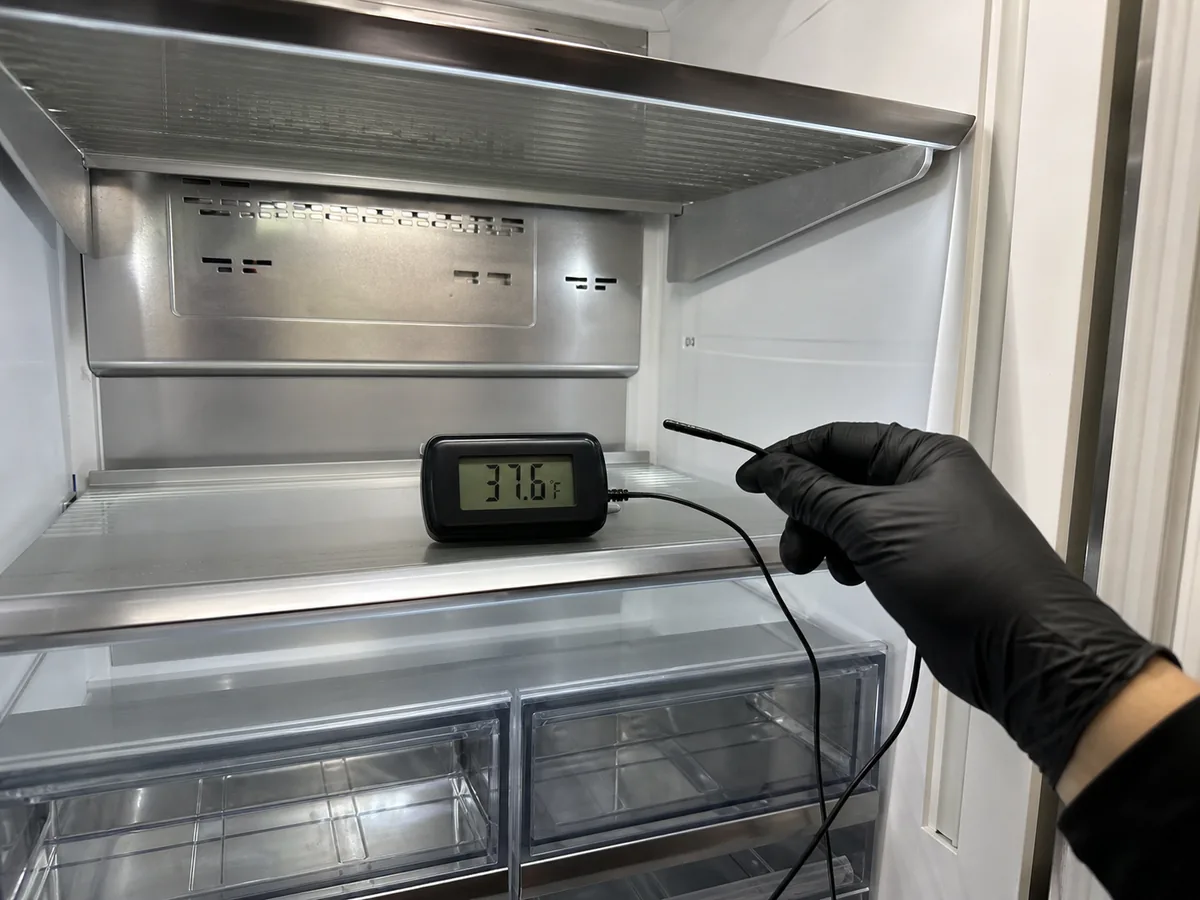
Take a real reading, ignore the display. Stand a small cup of water with a thermometer in it on a middle shelf and give it twenty minutes. A sound freezer settles near 0°F; numbers wandering into the teens mean trouble is starting; anything past the mid-20s means the cold is genuinely gone and the call is urgent.
Prove the refrigerator half is still cold. Drop a second thermometer into the fresh-food compartment. If it is sitting around 37°F while the freezer runs warm, that split result is your single strongest clue — it says the freezer's own circuit has failed, not the whole machine.
Check behind the bottom basket. Slide the lower basket out and study the panel at the back of the freezer. A thick slab of frost or ice across it says the auto-defrost has fallen behind; a clean panel steers you toward airflow, the fan, or the refrigeration circuit instead.
Clear the easy chokeholds. Confirm food is not jammed against the rear outlets, the door or basket shuts square, and the condenser grille is not matted with dust — especially on a unit that has run hard through a valley summer. Any one of these starves airflow and reads just like a broken part.
Write down the numbers and schedule. Note the actual freezer reading, whether the fridge side is normal, and the frost pattern, then photograph the model-serial plate. Bring all of it to the visit so a defrost part, a fan, or a refrigeration fault can be settled on the first trip.
Why this happens in Pleasanton
Inland heat, garage freezers, and twin-column kitchens
From June into September the Tri-Valley sits well inland of the coastal fog, and afternoons in the high 90s and over 100°F are the norm. That heat is the biggest single reason this symptom turns up here, and it hits hardest on units living outside a conditioned kitchen. Plenty of Pleasanton homes keep a backup Sub-Zero or a chest freezer in a garage or bonus room, and in a Vintage Hills or Ruby Hill garage that touches 110°F by mid-afternoon, a freezer is being asked to shed heat into air nearly as warm as the space it is fighting. A part that was quietly fading — a worn fan, a defrost component near the end — then slips into a no-freeze the first hot stretch of the year.
The newer remodels in Bridle Creek and Birdland bring the other Pleasanton pattern: a refrigerator tower and a freezer tower set apart instead of one combined unit. Since each tower is a standalone machine with its own compressor and condenser, a household can run a faultless refrigerator beside a freezer that will not hold a cube — and the freezer tower, working against the bigger temperature gap, feels a loaded condenser first. The repair is the same anywhere, but in a twin-column kitchen we diagnose the freezer as the independent machine it really is.
Backup freezer in our garage gave up during that first 104-degree stretch in July. He explained the garage was simply too hot for it to keep up, then found the defrost part had quit on top of that. Fixed it and gave us a straight answer about where to keep the unit. Recovered overnight.
— Tom B., Pleasanton 94588 (Vintage Hills)
★★★★★
Our freezer tower was climbing into the 20s while the refrigerator tower right next to it stayed a perfect 37. I thought the whole thing was dying. He showed me they are two separate machines, traced it to the freezer's own fan, and swapped it the same visit. No upsell, no drama.
— Priya N., Pleasanton 94566 (Bridle Creek)
★★★★★
Solid sheet of frost across the back panel of the freezer and food going soft. Turned out to be a defrost fault, not the compressor I was dreading. He cleared the ice, replaced the part, and checked the door seal while he was there. Came out to our Birdland house the next morning.
— Mark D., Pleasanton 94566 (Birdland)
FAQ
Freezer-not-freezing questions
How can the freezer be warm when the refrigerator beside it is cold?
Because a built-in Sub-Zero is really two refrigerators sharing one cabinet. Each side has its own compressor, coil, and air path, so the freezer can fail outright while the fresh-food compartment keeps a flawless temperature. A warm freezer next to a cold fridge is expected behavior, not a contradiction.
What goes wrong most often?
An iced-up evaporator from a defrost fault leads by a wide margin. The defrost part stops clearing the coil, frost packs over it, and the buried coil can no longer draw heat from the air. With that ruled out, a stalled freezer fan or a refrigeration loss is next in line.
Why does my garage backup freezer give out every Pleasanton summer?
Garages and converted rooms in Vintage Hills and Ruby Hill can climb past 110°F on a triple-digit afternoon, and a refrigeration system asked to dump heat into air that hot loses its margin fast. Often a marginal part is hiding underneath — a fading fan or an aging defrost component — that only crosses the line once the heat strips away its cushion.
Is a freezer sitting at 20°F an emergency?
It is on its way down, not gone. Food still below zero is safe for the moment, so treat it as urgent rather than a crisis. A freezer in the 20s and climbing should be scheduled soon, before the warmth starts dragging on anything that shares its air or cabinet.
Could it just be packed too full or a bad seal?
Yes, and both deserve a look before you assume a part died. Cartons against the rear outlets stop the return air, and a door or basket that no longer seals lets warm kitchen air pour in all day. Either can warm a freezer enough to look like a breakdown that never actually happened.
What does the repair run in Pleasanton?
A defrost part or a freezer fan is a mid-range job; a refrigeration loss is the expensive end. The $89 diagnostic tells you which, confirms the model, and is credited toward the work, so you pay for an answer instead of a guess.
Pleasanton Sub-Zero Repair operates as an independent appliance service. We hold no affiliation with Sub-Zero Group, Inc., are not an authorized or endorsed dealer, and use the brand name only to describe the units we repair. Replacement parts are matched to your model and serial.
Give us the freezer reading and confirm the fridge half is still fine, and the technician arrives stocked for the likely fault. Your $89 visit fee comes off the repair when you go ahead.