Sub-Zero making noise: what the buzz, click, or rattle is telling you
A new Sub-Zero noise is a clue, not just an annoyance. Tell a calm hum from a fan grazing frost, a start relay on its way out, or shake broadcasting into custom Pleasanton cabinetry — and learn how to pin down which part is talking.
A built-in Sub-Zero is meant to disappear into the background, so the moment it starts buzzing, ticking, or rattling, the sound itself becomes the most useful diagnostic you have. Different parts fail with different voices, and learning to read them tells you whether you are facing a quick fix or something that needs attention before it worsens. The reassuring part: the most alarming noises — the buzz-then-silence, the loud grind — are usually the inexpensive repairs, not the catastrophic ones.
The trick is to locate the sound before you try to name it. A Sub-Zero speaks from two very different places: up at the top grille, where the compressor and condenser fan do the heavy lifting, and inside the cabinet against the back wall, where the evaporator fan pushes cold air. Work out which of those is talking, whether the noise tracks the cooling cycle, and whether you can feel it in the cabinetry, and you are most of the way to the answer. Each sound is matched to its likely cause below.
Match the sound to the part
What each Sub-Zero noise usually means
Condenser fan packed with hill dust
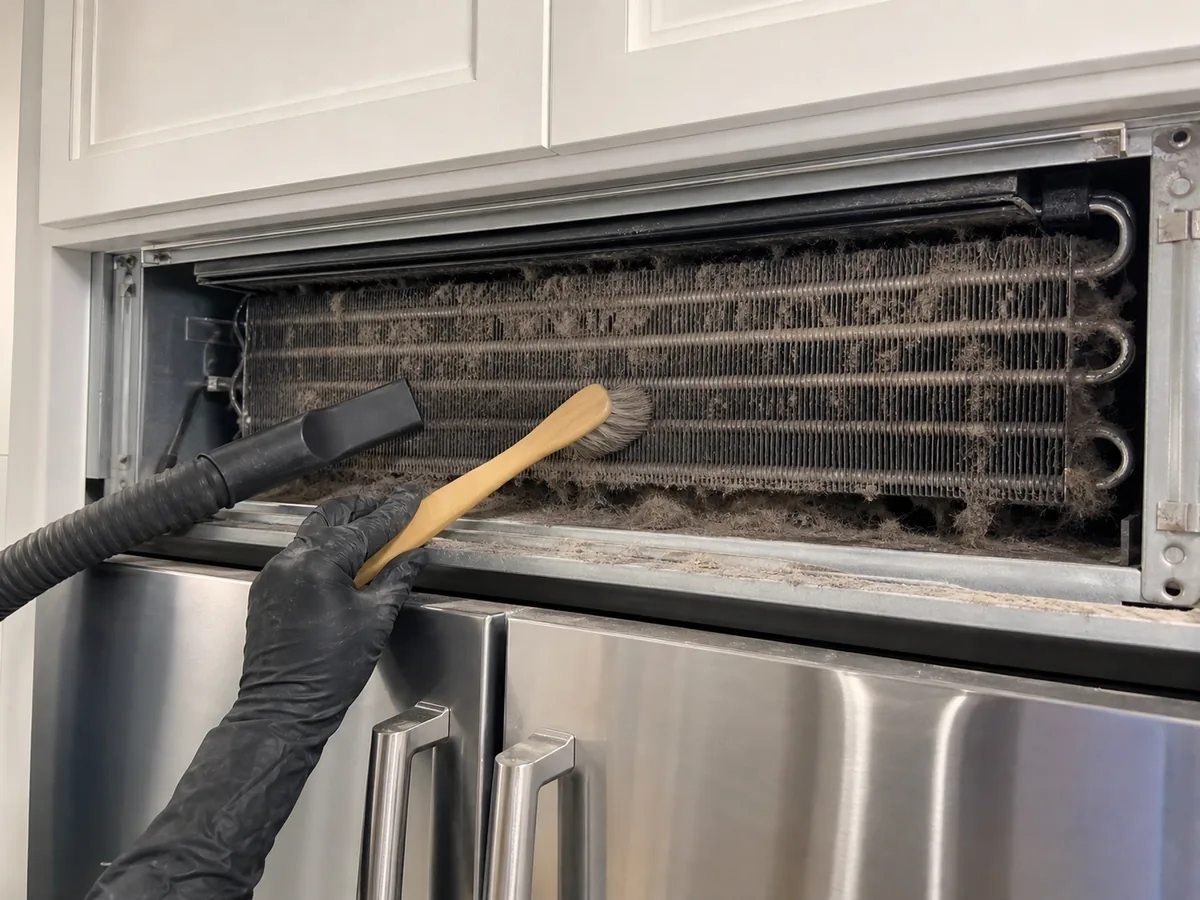
A harsh grind or scrape almost always rises from the condenser fan tucked behind the upper grille. In Pleasanton the powdery grit that blows off the open hills cakes that blade and its coil, the fan begins to drag, and the bearing wears out years early. Caught in time it is a cleanout and a fan; ignored, the motor seizes and the box starts to warm.
Evaporator fan grazing built-up ice
A tick or a rhythmic slap that swells when you open a compartment door usually means the inside fan is brushing a ridge of frost. That points as much at a defrost problem as a fan one, and it tends to travel with a side that is slowly losing its chill.
A start relay impersonating a dead compressor
A unit that hums for a second, snaps, and falls quiet is rarely a failed compressor. Far more often the small relay meant to bring it online has quit — a cheap, fast part. Telling that apart from a genuine compressor fault up front is what keeps a noise call from ballooning into a major bill.
Shake broadcasting through the millwork
Wedged tight into custom cabinetry, a built-in lets routine compressor shake pass into the surrounding panels, which behave like a drum skin and carry the hum along the run. A leveling foot wound loose or a perished mount turns a healthy, silent unit into a buzzing one with nothing actually broken.
The ice maker simply working
A handful of clicks and a short valve hum a few times a day are normally just the ice maker filling and dropping a batch — routine, not a fault. Shutting it off for a day is the quickest way to prove a periodic click is nothing more than ice on its way to the bin.
Do this first
Pin down the source before you call
Place the sound: upper grille or back wall. Get close and decide whether it comes from the grille up top, home to the compressor and condenser fan, or from inside the box against the rear wall, where the evaporator fan lives. That one call separates a machine-bay problem from a compartment one.
Open the doors one at a time. A sound that grows when the freezer opens belongs to that side's fan or coil; louder with the fresh-food door open points there instead. Unchanged with either door open, it is coming from the sealed-system bay rather than the cabinet.
Lay a hand on the cabinet face. Rest your palm lightly on the panel and the trim around it. If the woodwork buzzes harder than the appliance, you are feeling shake passing into the cabinetry, not a part on its way out — common in the tight custom installs around town.
Mute the ice maker overnight. Switch the ice maker off and listen the next day. If the stray clicks and the brief valve hum vanish, that is your answer and nothing needs fixing. A grind, buzz, or rattle that carries on is a mechanical fault worth a look.
Grab a clip and schedule. Record ten seconds with the door open, jot down when it happens, and snap the model tag. A clean recording lets a fan, relay, or mount be confirmed fast instead of waiting for the noise to resurface mid-visit.
Why this happens in Pleasanton
Dusty ridgelines and quiet downtown rooms
Two opposite kinds of Pleasanton home generate most of the noise calls, for opposite reasons. The first is the house that backs open space — the lots along Kottinger Ranch and the homes tucked beneath the ridgelines toward Augustin Bernal Park and the Pleasanton Ridge. The dry, fine dust that pours off those hills is exactly what loads an upper-grille condenser fan, and a coated blade drags, runs hot, and grinds its bearing down long before its time. In these homes a noise diagnosis and a condenser cleaning usually go together, and keeping the coil clear is the cheapest noise prevention there is.
The second is the quiet, open-plan home — the Downtown lofts and Main Street condos where there is barely any background sound to hide behind. A built-in that would slip by unnoticed in a busy household becomes obvious the instant a fan or relay changes its tune, and owners here tend to catch a problem at the very first new sound. That is genuinely an advantage: a fan caught before it seizes, or a relay caught before it strands the compressor, is the smallest version of the repair. Either way, a sound that is new, growing, or paired with warming earns a look rather than a wait.
If the noise travels with a side losing its cold, follow it to the matching symptom: a warm freezer points to freezer not freezing, and a whole box warming belongs on the not cooling diagnostic. A buzz-then-snap at the compressor is on the sealed system and compressor page, and the maintenance calendar lays out how often a Pleasanton condenser should be cleared.
What Pleasanton Sub-Zero owners say
Recent noise and vibration repairs
★★★★★
Loud grinding whir from the top grille that got worse over a week. He pulled the upper panel and the condenser fan was packed with the fine dust we get off the ridge, and the bearing was going. Cleaned it out, replaced the fan, and the kitchen went quiet again. Smart, tidy work.
— Alan R., Pleasanton 94566 (Kottinger Ranch)
★★★★★
In our open-plan loft downtown you hear everything, and the fridge started a buzz that snapped into a click and then went silent. I assumed compressor and a huge bill. It was the start relay — a fraction of what I feared. He had the part on the truck and was done in under an hour.
— Sofia L., Pleasanton 94566 (Downtown)
★★★★★
Our built-in started humming hard enough to feel in the cabinet face. Nothing was actually broken — a leveling foot had wound loose and the shake was travelling into the millwork. He re-seated it and showed me what to watch for. Honest call instead of selling me a part.
— Hector V., Pleasanton 94588 (Vintage Hills)
FAQ
Noise and vibration questions
Which Sub-Zero sounds are fine and which are not?
Fine: a low, steady drone from the compressor, a gentle whir off the fans, a faint gurgle as refrigerant shifts, and the odd click from the ice maker or defrost timer. Worth a look: a loud buzz or rattle, a grinding or scraping note, a steady knock, or a hum that snaps into a click and goes silent.
What makes one buzz loudly?
Two usual sources. A condenser or evaporator fan grazing ice or running on a worn bearing will buzz or grind. Separately, a compressor that tries, hums briefly, then snaps off is usually the start relay or overload rather than the compressor — and that gap changes the entire repair.
Why does my fridge click every few hours?
Mostly routine. The defrost timer flips the system into a defrost run on a set schedule, and the ice maker clicks as it loads and drops cubes. Paired with warming or with no ice it is worth checking; on its own, a click here and there is the unit doing its job.
The fan sounds like it is striking something. Is that serious?
It can be. A blade that taps or scrapes often means ice has stacked up near the coil and the fan is brushing it, which usually travels with a defrost problem and a warming side. A worn fan bearing makes a similar grinding note. Either is best seen before the motor quits for good.
Why is my built-in suddenly louder than before?
Set tight into custom cabinetry, the cabinet works like a drum skin. As mounts age or a leveling foot backs off, ordinary compressor shake passes into the millwork and is amplified down the run. The appliance may be perfectly sound; the cure is re-seating and isolating it, part of any noise diagnosis.
Is a quiet downtown condo more likely to notice a new noise?
Yes — and that helps. In an open-plan Downtown Pleasanton loft or a Main Street condo there is almost no background sound to bury a built-in, so a fresh buzz or rattle stands out early. Catching a fan or relay at that first new sound, before it fails outright, is exactly when the repair is smallest.
Pleasanton Sub-Zero Repair operates as an independent appliance service. We hold no affiliation with Sub-Zero Group, Inc., are not an authorized or endorsed dealer, and use the brand name only to describe the units we repair. Replacement parts are matched to your model and serial.
Describe where the sound lives and whether the box is warming, and the technician arrives stocked for the likely part. Your $89 visit fee comes off the repair when you go ahead.